Sunday, August 1, 2010
Saturday, July 31, 2010
Quote of the day
Diana closed her eyes. What a shame that the senses could not be more deliberate. The centres of auditory processing and speech recognition, so adept at screening out the irrelevant and the nonsensical, could do so little to obstruct bullshit. The mind was insufficiently selective. It would be better if stupidity and intelligence were mutually invisible, passing through one another like waves at different frequencies, different spectra. No need for politeness, no need to justify oneself, no more deference to the commonplace. Just solitude. The pandemonium of incorrectness and everywhere half-truth and agreed-upon-falsehood, the ocean of lesser waves, would appear only as a turbulent, benign silence.


Friday, July 30, 2010
Trust Enbridge with pipeline across BC?
 Enbridge has history of pipeline problems, 30 enforcement actions since 2002
AP: A Canadian company whose pipeline leaked [3.8 million litres] of oil into a Michigan river boasts on its website of being 'an industry leader in pipeline safety and integrity.' A decade's worth of leaks, an explosion and regulatory violations throughout the Great Lakes region and elsewhere in the U.S. suggest otherwise.
Enbridge Inc. or its affiliates have been cited for 30 enforcement actions since 2002 by the Pipeline and Hazardous Materials Safety Administration -- the U.S. Department of Transportation's regulatory arm...
An Enbridge affiliate, Houston-based Enbridge Energy Co., spilled almost 72,000 litres of crude oil onto Wisconsin's Nemadji River in 2003. Another 715,000 litres of oil spilled at the company's terminal three kilometres from Lake Superior... In 2007, two spills released about 760,000 litres of crude in northern Wisconsin as Enbridge was expanding a 500-kilometre pipeline. The company also was accused of violating Wisconsin permits designed to protect water quality during work in and around wetlands, rivers and streams.
Bruce Bullock, director of Maguire Energy Institute at Southern Methodist University's Cox School of Business, said... 'They don't have a reputation of being particularly a star player in terms of their profile or anything like that, but they certainly have a good reputation in terms of delivering for their shareholders.'...
Andy Buchsbaum, director of the National Wildlife Federation's Great Lakes office, said Enbridge has a history of spills - including two major leaks in the past year. He said those leaks, coupled with the fatal blast in Minnesota that killed two workers, are problematic. 'This is a company whose safety record is very definitely suspect and cause for concern.'
Thursday, July 29, 2010
Data 'screaming that the world is warming'
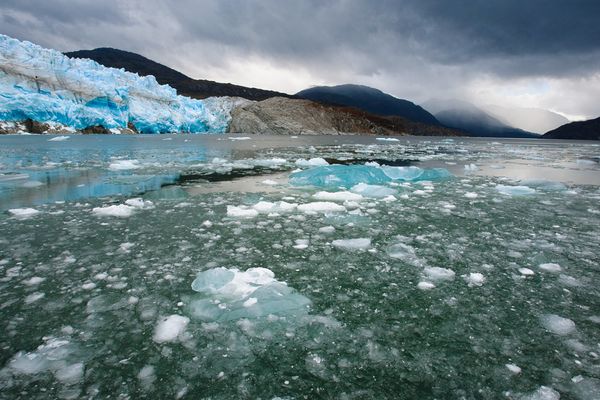
National Geographic: And it's happening fast... An in-depth analysis of ten climate indicators all point to a marked warming over the past three decades, with the most recent decade being the hottest on record, according to the latest of the U.S. National Atmospheric and Oceanic Administration's annual 'State of the Climate' reports... Reliable global climate record-keeping began in the 1880s...
Three hundred scientists analyzed data on 37 climate indicators, but homed in on 10 that the study says are especially revealing: humidity, sea-surface temperature, sea ice cover, ocean heat content, glacier cover, air temperature in the lower atmosphere, sea level, temperature over land, and temperature over oceans... Such climate shifts are already ushering in extreme weather, which plagued much of the globe in 2009...
The NOAA report -- published in the Bulletin of the American Meteorological Society -- is different from other climate publications, because it's based on observed data, not computer models, making it the 'climate system's scorecard.'
The Globe and Mail: 'The conclusion is unmistakable -- yes, the planet is warming,' said Derek Arndt, a co-editor of the report... 'The facts speak for themselves, and speak simultaneously... They all point toward the same conclusion -- the globe is warming.' The report... pulled together data from 10 climate indicators measured by 160 research groups in 48 countries. The scientists compared the figures decade by decade as far back as possible, more than 100 years in some cases.
AP: The new report noted that continual warming will threaten coastal cities, infrastructure, water supply, health and agriculture. 'At first glance, the amount of increase each decade... may seem small,' the report said. 'But' it adds, 'the temperature increase... experienced during the past 50 years has already altered the planet. Glaciers and sea ice are melting, heavy rainfall is intensifying and heat waves are becoming more common and more intense.'...
The 10 [measures] were selected 'because they were the most obviously related indicators of global temperature,' explained Peter Thorne of the Cooperative Institute for Climate and Satellites, who helped develop the list when at the British weather service, known as the Met Office. 'What this data is doing is, it is screaming that the world is warming.'
Wednesday, July 28, 2010
Arctic ship find: Inuit history plus high tech

The Toronto Star: A Parks Canada team of archaeologists has found the wreck of the ship abandoned 155 years ago by the crew credited with discovering the Northwest Passage. The remains of the HMS Investigator were detected eight metres below the surface of Mercy Bay, off the shores of Banks Island in the Northwest Territories, where Capt. Robert McClure and his crew were trapped by ice in the mid-1850s for two winters.
McClure had been dispatched from England to rescue the missing Sir John Franklin and his two ships, the Erebus and the Terror, but found neither vessel, Franklin nor any trace of his 128 crewmen... After this current 12-day search for Investigator and artifacts left in an on-shore Bank Island cache by McClure's crew, Canadian archaeologists will again attempt to locate Terror and Erebus farther south, off O'Reilly Island, for three weeks in August....
Prior to leaving for the Investigator expedition, Parks Canada marine archeologist Ryan Harris said finding McClure's ship would validate Inuvialuit oral history. The western Arctic people had long known where the largely intact ship sank after McClure abandoned it.

The Globe and Mail: 'The ship had not moved too much from where it was abandoned.' [said] Marc-Andre Bernier, Parks Canada's head of underwater archaeology... The masts and rigging have long been sheared off by ice and weather. But the icy waters of the McClure Strait have preserved the vessel in remarkably good condition...
Archaeologists have been uncovering a trove of artifacts on land left behind by the stranded sailors, who unloaded everything that was usable and portable before abandoning the Investigator. The graves of three sailors thought to have died of scurvy have been marked off and will be left undisturbed...
The Investigator is also considered to be a significant part of aboriginal history... For years after the ship was abandoned, Inuvialuit hunters scavenged the site for valuable and rare bit of metal and wood. Even the nails were pulled out of one of the boats left behind. 'This is alive in Inuvialuit memory today,' Mr. Bernier said.
The next step will be to send down a remotely controlled video camera to get actual pictures of the wreck. There are no plans to bring it to the surface and all legal steps will be taken to ensure the site remains protected.
Tuesday, July 27, 2010
10,000 year-old 'Woman of the Palms'
 Ancient woman suggests diverse migration
AP: A scientific reconstruction of one of the oldest sets of remains found in the Americas appears to support theories that the first people who came to the hemisphere migrated from a broader area than once thought. Mexico's National Institute of Anthropology and History on Thursday released photos of the reconstructed image of a woman who probably lived on Mexico's Caribbean coast 10,000 to 12,000 years ago...
Anthropologists had long believed humans migrated to the Americas in a relatively short period from a limited area in northeast Asia across a temporary land corridor that opened across the Bering Strait during an ice age. But government archaeologist Alejandro Terrazas says the picture has now become more complicated, because the reconstruction more resembles people from southeastern Asian areas like Indonesia.'...
Ripan Malhi, assistant professor of anthropology at the University of Illinois, said that 'using facial reconstructions to assign ancestry to an individual is not as strong as using ancient DNA... because the environment can influence the traits of the face.'... However, there have been few opportunities to use DNA or other methods to identify the origins of the first inhabitants because only a handful of skeletons from 10,000 years ago have survived...
The female is known as 'La Mujer de las Palmas,' or 'The Woman of the Palms,' after the sinkhole cave near the Caribbean resort of Tulum where her remains were found by divers and recovered in 2002. Because rising water levels flooded the cave where she died or was laid to rest, her skeleton was about 90 percent intact. Archaeologists and physical anthropologists calculated she was between 44 and 50 years old when she died, was about 5 feet (1.52 meters) tall and weighed about 128 pounds (58 kilograms).
Susan Gillespie, an associate professor of anthropology at the University of Florida, noted that ... 'the situation is messier than the straightforward scenario... of big game hunters chasing wooly mammoths over the exposed Bering bridge to Alaska. Recently there has been more serious inquiry into the various origins of migrants, modes of transportation, and dates of when they got here... Dates for peopling of the Americas have been pushed way back, and with the finding of very early skeletal remains, the genetic/skeletal linkages to peoples of northeast Asia has become more cloudy.'
But Gillespie cautioned against comparing a reconstructed face from 10,000 years ago to modern populations in places like Indonesia, which have also probably changed over 10 millennia. 'You have to find skeletons of the same time period in Asia, or use genetic reconstructions, to make a strong connection, and cannot relay on modern populations... Do we have any empirical data on what Southeastern Asian women looked like... 10,000 years ago?'
Monday, July 26, 2010
US in Iraq: Radioactive Fallujah
 Toxic legacy of US assault on Fallujah 'worse than Hiroshima'
The Independent: Dramatic increases in infant mortality, cancer and leukaemia in the Iraqi city of Fallujah, which was bombarded by US Marines in 2004, exceed those reported by survivors of the atomic bombs that were dropped on Hiroshima and Nagasaki in 1945, according to a new study.
Iraqi doctors in Fallujah have complained since 2005 of being overwhelmed by the number of babies with serious birth defects, ranging from a girl born with two heads to paralysis of the lower limbs. They said they were also seeing far more cancers than they did before the battle...
Their claims have been supported by a survey showing a four-fold increase in all cancers and a 12-fold increase in childhood cancer in under-14s. Infant mortality in the city is more than four times higher than in neighbouring Jordan and eight times higher than in Kuwait...
US Marines first besieged and bombarded Fallujah, 30 miles west of Baghdad, in April 2004 after four employees of the American security company Blackwater were killed and their bodies burned. After an eight-month stand-off, the Marines stormed the city in November using artillery and aerial bombing... US forces later admitted that they had employed white phosphorus as well as other munitions...
In the assault US commanders largely treated Fallujah as a free-fire zone... British officers were appalled by the lack of concern for civilian casualties... Dr [Chris] Busby says that while he cannot identify the type of armaments used by the Marines, the extent of genetic damage suffered by inhabitants suggests the use of uranium in some form. He said: 'My guess is that they used a new weapon against buildings to break through walls and kill those inside.'...
Researchers found a 38-fold increase in leukaemia, a ten-fold increase in female breast cancer and significant increases in lymphoma and brain tumours in adults... Dr Busby says what is striking is not only the greater prevalence of cancer but the speed with which it was affecting people. Of particular significance was the finding that the sex ratio... From 2005 there was an 18 per cent drop in male births... an indicator of genetic damage that affects boys more than girls. A similar change in the sex-ratio was discovered after Hiroshima...
The impact of war on civilians was more severe in Fallujah than anywhere else in Iraq because the city continued to be blockaded and cut off from the rest of the country long after 2004.
Related:
The Times (London): Environmental scientists who uncovered the evidence through freedom of information laws say it is evidence that depleted uranium from the shells was carried by wind currents to Britain... The 'shock and awe' campaign was one of the most devastating assaults in modern warfare. In the first 24-hour period more than 1,500 bombs and missiles were dropped on Baghdad.
Truthout: What is happening in Iraq seems to reflect what psychiatrist Robert Jay Lifton calls 'atrocity-producing situations.' He used this term first in his book The Nazi Doctors... 'A counterinsurgency war in a hostile setting, especially when driven by profound ideological distortions, is particularly prone to sustained atrocity -- all the more so when it becomes an occupation.'
Sunday, July 25, 2010
The Afghanistan Papers, thanks to Wikileaks
 Wikileaks today released over 75,000 reports covering the war in Afghanistan... The Afghan War Diaries is the most significant archive about the reality of war to have ever been released during the course of a war. We hope the impact will lead to a comprehensive understanding of the war in Afghanistan and modern warfare in general... The Afghan War Diaries can be viewed in chronological order by over 100 categories... The reports can also be viewed by 'severity,' where severity is proportionate to the number of people killed, injured, or detained...
The Afghan War Diaries show how cover-ups start on the ground. When reporting their own activities US Units are inclined to classify civilian kills as insurgent kills, downplay the number of people killed or otherwise make excuses for themselves... This archive shows the vast range of small tragedies that are almost never reported by the press but which account for the overwhelming majority of deaths and injuries resulting from the war.
We have delayed the release of some 15,000 reports from total archive as part of a harm minimization process demanded by our source. After further review, these reports will be released, with occasional redactions, and eventually, in full.
Wikipedia: Wikileaks subsequently made the logs, some 91,731 documents covering the period between January 2004 and December 2009, available to The Guardian, The New York Times, and Der Spiegel, who published reports per previous agreement... The material revealed that, in general NATO forces in Afghanistan have made little progress in stabilizing the country.
This is a screen shot. For the interactive map go here.

A huge cache of secret US military files today provides a devastating portrait of the failing war in Afghanistan, revealing how coalition forces have killed hundreds of civilians in unreported incidents... Some of these casualties come from the controversial air strikes... but a large number of previously unknown incidents also appear to be the result of troops shooting unarmed drivers or motorcyclists out of a determination to protect themselves from suicide bombers... Bloody errors at civilians' expense... include the day French troops strafed a bus full of children... A US patrol similarly machine-gunned a bus... and Polish troops mortared a village, killing a wedding party including a pregnant woman, in an apparent revenge attack.
The documents' release comes at a time when calls for a withdrawal of troops from Afghanistan are growing -- even in America... Shows of optimism seem cynical in light of the descriptions of the situation provided in the classified documents... They portray Afghan security forces as the hapless victims of Taliban attacks. They also offer a conflicting impression of the deployment of drones, noting that America's miracle weapons are also entirely vulnerable.
The big news is that the Taliban have been using surface to air missiles... against helicopters and fixed-wing aircraft, which has been kept very quiet... The conflict has clearly been going worse, for longer, than we've been led to believe, even correcting for the suspicion that we were being misled... The amount of friendly fire incidents is really high... The sheer number of civilians wounded and killed as a matter of course is depressing. From little girls getting run over by humvees to teenagers on bikes getting shot at roadblocks to entire families getting taken out by airstrikes... it makes you wonder how there can possibly be any goodwill left at all, any hearts and minds left to be won over.
Monarch journey 'even more spectacular'
 Monarch migration mystery solved by Canadian researchers
The Canadian Press: A new Canadian study has apparently solved a mystery involving the migration habits of one of North America's most recognizable insects and may aid conservation efforts.
Scientists have been trying to understand why monarch butterflies east of the Appalachians showed up later in the year than those found west of the mountain range, which runs roughly from Atlantic Canada to Alabama. Researchers from the University of Guelph and Environment Canada have proved monarch butterflies migrate eastward over the Appalachians as they repopulate.
The butterflies recolonize 'multigenerationally,' meaning the generation that winters in Mexico flies northward, laying eggs west of the Appalachians, which then hatch into butterflies that head toward the eastern coast of the U.S. The finding is unusual because most recolonization patterns follow a more simple south to north pattern...
The monarch... is already famous for its long annual migration to Mexico. With this latest information scientists now know the insect's journey is even more spectacular than originally thought. Weighing only a few grams, the delicate butterfly battles harsh conditions to make it to the other side of the Appalachians. Researchers were able to make the discovery by analysing wing tissue and tracing the butterflies to their birthplaces...
Aside from solving a migration mystery, the study is significant because it will allow conservation efforts to be more effective... The study suggests the most productive monarch populations are in the Great Lakes and the mid-western United States... [Nathan] Miller.. one of two researchers who collected the samples... said monarch butterflies are surprisingly hard to catch. 'They are actually pretty fast and they're very aware of people.'
Saturday, July 24, 2010
Why depression is black and grey
 Depression really does turn the world grey, study shows
Healthzone.ca: Depression has long been associated with darkness and grey skies, but a new study suggests there might actually be a scientific basis for these cultural motifs. A new paper published in Biological Psychiatry suggests people who are clinically depressed have difficulty detecting the contrast between black and white...
Tebartz van Elst, head of the section for neuropsychiatry and deputy director of the Clinic for Psychiatry and Psychotherapy at Germany's University of Freiburg... says the relationship between depression and poor black-and-white contrast perception might exist because receptive fields in the retina that are critical for perceiving contrast involve dopamine, one of the key neurotransmitters involved in depression. [He] says he and his team have discovered 'an objective marker of the subjective state of depression' which could have implications for diagnosis and treatment...
Dr. Mark Berber, a psychiatrist at Markham Stouffville Hospital, professor at Queen's University and lecturer at the University of Toronto, says his patients who struggle with depression often say things seem bleak; when they're well, they say the world has a more vibrant colour... 'When you're depressed, everything seems grey and black.'
This phenomenon has long been noted in literature. University of Toronto English profession Carroll says that before the rise of modern science, melancholy was attributed to 'black bile.' one of the four humours, believed to cast a shadow over the mind... This experience was noted by Winston Churchill, who called his depression 'the black dog.' In 1911, he wrote to his wife that his black dog had left him, at least for the time being. 'All the colours come back into the picture,' he wrote.
Friday, July 23, 2010
Map of the day: Global forest heights

View larger image with zoom option.
The new map shows the world's tallest forests clustered in the Pacific Northwest of North America and portions of Southeast Asia, while shorter forests are found in large swaths across northern Canada and Eurasia. The map depicts average height over 5 square kilometers (1.9 square miles), not the maximum heights that any one tree or small patch of trees might attain.
Temperate conifer forests -- which are extremely moist and contain massive trees such as Douglas fir, western hemlock, redwoods, and sequoias, have the tallest canopies, soaring earily above 40 meters (131 feet). In contrast, boreal forests dominated by spruce, fir, pine, and larch had canopies typically less than 20 meters (66 feet). Relatively undisturbed areas in tropical rain forests were about 25 meters (82 feet), roughly the same height as the oak, beeches, and birches of temperate broadleaf forests common in Europe and much of the United States.
Scientific interest in the new map goes far beyond curiosities about tree height. The map has implications for an ongoing effort to estimate the amount of carbon tied up in Earth's forests... There are hints that young forests absorb more carbon than older ones, as do wetter ones, and that large amounts of carbon end up in certain types of soil. But ecologists have only begun to pin down the details as they try to figure out whether the planet can continue to soak up so much of our annual carbon emissions and whether it will continue to do so as climate changes.
Thursday, July 22, 2010
US in Iraq: nothing new here, but when's the trial?
 Former M15 spy agency chief says there was no link between Iraq and 2001 attacks on US
AP: The war in Iraq led to a loss of focus on the threat from al-Qaida, emboldened al-Qaida leader Osama bin Laden and helped to breed a generation of homegrown terrorists, Britain's former domestic spy chief told a U.K. inquiry...
Eliza Manningham-Butler, director of the MI5 agency between 2002 and 2007, said Britain's government paid little attention to warnings that the war would fuel domestic terrorism. [She] also said Iraq had posed little threat before the 2003 invasion, and insisted there was no evidence of a link between former Iraqi dictator Saddam Hussein and the Sept. 11 attacks on the United States.
'There was no credible intelligence to suggest that connection and that was the judgment, I might way, of the CIA,' she told the inquiry. 'It was not a judgment that found favour with some parts of the American machine.'... 'It is why [then-U.S. Defence Secretary Donald Rumsfeld] started an alternative intelligence unit in the Pentagon to seek an alternative judgment.'...
MI5 disagreed with then-Prime Minister Tony Blair over a key justification for the war -- Iraq's purported harbouring of weapons of mass destruction. She said the belief that Iraq might use such weapons against the West 'wasn't a concern in either the short term or the medium term to either my colleagues or myself.'...
'Our involvement in Iraq radicalized... a whole generation of young people... who saw our involvement in Iraq, on top of our involvement in Afghanistan, as being an attack on Islam,' she said... Video messages left by the four suicide bombers who killed 52 commuters in the 2005 attacks on London's subway and bus network had referred to Britain's role in Iraq... 'Arguably we gave Osama bin Laden his Iraqi jihad.'...
The ex-spy chief, giving evidence in a public session, said she had been asked by the British government after the invasion to persuade deputy U.S. Defence Secretary Paul Wolfowitz to ditch his plan to disband Iraq's army. She said she found she had 'not a hope' of changing Wolfowitz's mind.
Related:
Wednesday, July 21, 2010
Himalaya glacier melt rate 'extreme'
Comparative photos of Mount Everest 'confirm ice loss'

BBC News: Photos taken by a mountaineer on Everest from the same spot where similar pictures were taken in 1921 have revealed an 'alarming' ice loss. The Asia Society (AS) arranged for the pictures to be taken in exactly the same place where British climber George Mallory took photos in 1921. 'The photographs reveal a startling truth: the ice of the Himalaya is disappearing,' an AS statement said. 'They reveal an alarming loss in ice mass over an 89-year period.'...
The AS says that the findings are 'vitally important' because the Himalaya is home to the world's largest sub-polar ice reserves. The melt waters of these high altitude glaciers supply crucial seasonal flows to the Ganges, Brahmaputra, Salween, Irrawaddy, Mekong, Yangtze and Yellow rivers, which hundreds of millions of people downstream depend on for their livelihoods,' the statement said...
Mr [David] Breashears retraced the steps of the 1921 British Mount Everest Reconnaissance Expedition Team, using photos taken then by surveyor and photographer Maj Edward Wheeler and amateur photographer George Mallory, who later died attempting to reach the Everest summit in 1924.
'The melt rate in this region of central and eastern Himalaya is extreme and is devastating,' Mr Breashears told an AS meeting... He has not only followed in the footsteps of Mallory but also those of Italian photographer Vittorio Sella, whose work spanned the 19th and 20th Centuries. The result is a then-and-now series of photographs from Tibet, Nepal and near K2 in Pakistan -- all of which show glaciers in retreat.
Tuesday, July 20, 2010
Help choose BP's new logo
Vote for a new face for BP (complete gallery here)
Greenpeace UK: We asked you to help us rebrand BP by designing a logo that better suits their dirty business. Now it's time for you to choose a winner. Vote here.

Subscribe to:
Comments (Atom)