Saturday, April 30, 2011

Will Harper provoke constitutional crisis?

Harper refuses to say if he would accept governor general's decision on coalition (includes VIDEO)

Canada.com: Richmond Hill, Ont: Conservative leader Stephen Harper refused Saturday to say if he would accept a decision by the governor general to hand power to one of the opposition parties after Monday's election... After five weeks during which Harper has, on a daily basis, said that the opposition parties will form a coalition government if he doesn't win a majority, Harper would not say if he would publicly accept or oppose a decision by Gov.-Gen David Johnston to make that happen.

Under constitutional tradition, say experts, if Harper is defeated in the House of Commons by the opposition parties, it will then be up to Johnston to decide if he wants to ask one of the opposition leaders if they have the 'confidence' of the House and form a government. Only upon that invitation by the governor general would a new government be formed -- meaning it is Johnston, not Harper, who has the constitutional power...

At a campaign event Saturday... Harper was asked a direct question. 'Will you or will you not accept a decision by the governor general to call on the second party to form a government if you again lose the confidence of the House?'... Despite being asked repeatedly by a reporter to answer the question, Harper declined... His refusal to answer... raises fundamental questions about whether Harper will provoke a constitutional crisis in the wake of an election...

When a CBC TV reporter continued to press for an answer Saturday, Harper shot back, 'I've given you my answer.' Someone in the crowd shouted out 'Shut down the CBC!' prompting cheers from Harper's supporters.

Friday, April 29, 2011

Constitutional expert 'full of fear' of Harper majority


VIDEO: Leading constitutional expert Peter Russell on Speak Up/Parler Fort. Watch it here.


"I've never been more worried in my entire lifetime about the possible outcome of an election. I really fear that if the Harper Conservatives were to win a majority in the the of House of Commons it would be an indication that parliamentary crime pays... I really tremble. I'm just full of fear... It's a scary election... and an important one for Canadians. Whether we really treasure the parliamentary democracy we've enjoyed... for over a century and a half. I hope all Canadians will really worry and think about it and try to prevent a majority from killing."

Wednesday, April 27, 2011

A must read -- and pass it on

The daring Mr. Harper
Aaron Wherry, Maclean's: He is not creating alternate realities, he is simply daring enough to breeze past any assertion of reality which does not serve his purposes. He is looking you in the eye, shrugging and moving on. He is entirely undaunted by his own record of words and actions... What he has pitched throughout this campaign is a series of bold assertions -- or at least a series of assertions that must seem bold to anyone stubborn enough to hang on to recorded history.

Read the whole thing here.

Tuesday, April 26, 2011

Monday, April 25, 2011

Abstraction of Destruction


Facial Tissues, September 2005, Ontario

The Guardian: Paper pulp waste, resulting from facial tissue manufacture. At this factory, the pulp for the most popular facial tissue is produced. The wood fibre is obtained from the Kenogami national forest in Ontario, where the government subsidizes the cutting of old growth forest. The forest, once home for a multitude of species, is an immensely diverse and complex ecosystem and habitat, and will be replaced by a monoculture of factory farmed trees which will be cut again. This aeration pond is part of the effluent treatment system. The primary task of the treatment is to remove organics (wood fibre) from the water before it is returned to its source (typically a river). These ponds are filled with a mixture of micro-organisms that break down the organic material. The aeration is to break up particles in the effluent and to provide oxygen to the microbes.

From Abstraction of Destruction, J. Henry Fair's images of environmental degradation, most of them taken out of planes at 1,000 feet. The pictures appear in his recent book, The Day After Tomorrow: Images of Our Earth in Crisis.

Sunday, April 24, 2011

God's wife Asherah: 'mighty and nurturing'

God's Wife Edited Out of the Bible -- Almost
Discovery.com: God had a wife, Asherah, whom the Book of Kings suggests was worshiped alongside Yahweh in his temple in Israel, according to an Oxford scholar. In 1967, Raphael Patai was the first historian to mention that the ancient Israelites worshiped both Yahweh and Asherah. The theory has gained new prominence due to the research of Francesca Stavrakopolou, who began her work at Oxford and is now a senior lecturer in the department of Theology and Religion at the University of Exeter...

Asherah's connection to Yahweh, according to Stavrakopolou, is spelled out in both the Bible and an 8th century BC inscription on pottery found in the Sinai desert at a site called Kuntillet Arjud. "The inscription is a petition for a blessing,... 'a blessing from Yahweh and his Asherah.'" Here was evidence that presented Yahweh and Asherah as a divine pair. And now a handful of similar inscriptions have since been found...

Also significant, Stavrakopoulou believes, "Is the Bible's admission that the goddess Asherah was worshiped in Yahweh's Temple in Jerusalem. In the Book of Kings, we're told that a statue of Asherah was housed in the temple and that female temple personnel wove ritual textiles for her."

J. Edward Wright, president of both the Arizona Center for Judaic Studies and The Albright Institute for Archaeological Research, [agrees]: Asherah was not entirely edited out of the Bible by its male editors... Asherah -- known across the ancient Near East by various other names, such as Astarte and Istar -- was "an important deity, one who was both mighty and nurturing."

"Many English translations prefer to translate 'Asherah' as 'Sacred Tree,'" Wright said. "This seems to be in part driven by a modern desire, clearly inspired by the Biblical narratives, to hide Asherah behind a veil once again."... Aaron Brody, director of the Bade Museum and an associate professor of Bible and archaeology at the Pacific School of Religion, said... Asherah as a tree symbol was even said to have been "chopped down and burned outside the Temple in acts of certain rulers who were trying to 'purify' the cult, and focus on the worship of a single male god, Yahweh."

The ancient Israelites were polytheists, Brody [said] "with only a small minority worshiping Yahweh alone before the historic events of 586 BC." In that year, an exile community within Judea was exiled to Babylon and the Temple in Jerusalem was destroyed. this, Brody said, led to "a more universal vision of strict monotheism: one god not only for Judah, but for all of the nations."

Image source here.

Saturday, April 23, 2011

Trees reflected

Ingrid Nelson, Pavement Trees: Last sumer I started shooting concrete and parking lots and dividing lines, fading paint and patterns... With all the rain this winter, my eye was drawn into the glistening cement and of course... puddles.


Thursday, April 21, 2011

Immigration experts warn against HarperCons

Don't vote Conservative, newcomers urged
Toronto Star: In an unusual move, a group of Canadian lawyers and legal academics are urging voters not to support the Conservative Party in the May 2 election. "The Conservative Party has been telling visible minority immigrant communities, which it calls the 'ethnic vote,' that it is improving the immigration system," said the group in a statement released [April 20]. "A review of their record shows the contrary." The group, made up of leading immigration lawyers and professors across Canada, said the Conservative Party has misled the public, especially immigrant voters, by making twisted statements about the state of Canada's immigration and refugee system, in order to win newcomer votes.


Despite the media hype and government propaganda, Canadian immigration experts, both academics and lawyers, do not think that the Conservative government is doing immigrant communities any favours.

Stephen Harper, Jason Kenney and the Conservatives have target the so-calle 'ethnic vote,' hoping to convince immigrant communities that the Conservatives have made things better fot their communities and that these communities should support them. However, a review of the facts shows that this government's policies have not been friendly to immigrant communities. Moreover, the Conservative government has made a habit of using immigration issues to stir up anti-immigrant sentiments amongst other Canadians.

[See list of specific charges here.]

If you believe in the concept of family reunification, that is the ability of immigrants and Canadians to bring their parents, grandparents, children and spouses to Canada; if you believe in a fair and timely skilled worker program that recruits the best and the brightest from around the world to join our midst; if you believe in justice for refugees without automatic imprisonment; if you believe in spousal sponsorship processing that does not lead to the potential for greater spousal abuse and neglect, then you must not support the Conservative Party in the upcoming Federal Election on May 2nd.

Wednesday, April 20, 2011

Canada #2 'happiest country'

Survey says: Canada is second happiest country in the world

National Post: According to a new global survey from Gallup, 69% of Canadians rated their lives as 'thriving' in 2010 -- putting the country in a tie with Sweden for second place in the rankings. The top spot belongs to Denmark, where 72% of residents are feeling pretty great about life...

Respondents had three options to choose from: 'thriving' -- where they classified their lives as 'a 7 or higher and their lives in 5 years an 8 or higher,' 'struggling,' or 'suffering.' Gallup's method is based on the Cantril Scale, which encourages participants to imagine a ladder with 10 steps (to signify a scale of 10). The top of the ladder is the best life imaginable, and as you can expect, 0 is the worst.
The top ten countries:
1. Denmark: 72%
2. Canada: 69%
2. Sweden: 69%
4. Australia: 66%
5. Finland: 64%
5. Venezuela: 64%
7. Israel: 63%
7. New Zealand: 63%
9. Netherlands: 62%
9. Ireland: 62%
The bottom 10 countries:
1. Chad: 1%
2. Central African Republic: 2%
3. Haiti: 2%
4. Burkina Faso: 3%
5. Cambodia: 3%
6. Niger: 3%
7. Tajikistan: 3%
8. Tanzania: 4%
9. Mali: 4%
10. Comoros: 4%
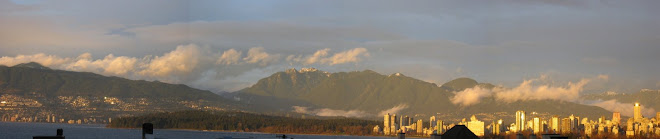
Image: Vancouver (Streeter Lecka/Getty Images); source here.

Tuesday, April 19, 2011

UBC lipdub video goes viral

Stunning UBC student lipdub
More than 1,000 students appear in the one-long-shot wonder

Vancouver Sun: A UBC lipdub video, filmed in one long shot on the school campus March 26, has gone viral on YouTube. The filmmakers say proceeds from the YouTube views will be donated to charity. Be prepared to be amazed as scores of students lip synch to Pink's 'Raise Your Glass' and Marianas Trench 'Celebrity Status.' Watch the video on YouTube, at the official UBC LipDub website or in the online Vancouver Sun article (along with other student lipdubs) here.

Monday, April 18, 2011

Ice retreat, permafrost melt eroding coastline


Canadian Press: Scientists suspect that gradual washing-away along thousands of kilometres of gravelly northern shoreline is speeding up. And that steady erosion is already having profound effects on northerners, the majority of whom live along the coast.

'Every single element of the North is going to be affected, right from the engineering side to how the Inuit interact with their environment,' said Wayne Pollard, a McGill University geomorphologist who contributed to the massive, 10-country study...

Much of Canada's northern coast is composed of a kind of frozen goo -- an unconsolidated pile of rubble and mud cemented into place by permafrost. It has always been subject to erosion from wind and waves. The study concludes the vast Beaufort Sea coastline of the western Arctic is retreating faster than any other northern coastline. On average, the sea washes away a metre of it every year. In some places, the erosion reaches eight metres a year...

The study point out that the sea ice is crucial to protecting the shore. And sea ice, in the face of climate change, is undergoing its own retreat. This year's sea ice maximum was tied for the lowest on record... Permafrost is also becoming less stable as temperatures in the North increase...

The changes are already affecting traditional practices such as hunting seals, polar bears and beluga whales. People so attuned to their local environment that they can navigate in fog by the currents affecting their boats can no longer count on the old assumptions... Pollard said the study underlines how interconnected the shoreline is with both the human and natural world.
Image source here.

Sunday, April 17, 2011

Citizenship guide: Canada as 'bellicose nation'

Canada for Spartans

In the government guidebook Discover Canada, required reading for people seeking to become Canadian citizens, the word 'war' appears thirty-five times and Ontario and Quebec become a single region

Stephen Henighan, in Geist (Spring 2011): If I did not recognize the land described in Discover Canada, that was the volume's intention: to drive a wedge between old Canadians and new Canadians... between the liberal, statist, internationalist culture of the past and what the authors hope will be the conservative, militaristic culture of the future...

Medicare... is bypassed in a fleeting reference to the Canada Health Act. Tommy Douglas may have been voted 'the Greatest Canadian' in 2004, but his name does not appear here. The CBC, government aid agencies,... the right to unionize, gay and lesbian rights -- all vanish... Peacekeeping receives one grudging mention... Canada is a bellicose nation, adamant about its 'Christian civilizations' and fixated on 'the rule of law.'...

The only two waves of political refugees identified by the guide are Hungarians who 'escaped Soviet tyranny' in 1956 and Vietnamese who 'fled from Communism' after 1975... [not] military governments in Chile, Argentina and Uruguay, or right-wing death squads in El Salvator or Guatemala... [or] men who came to Canada from the United States as refugees from the Vietnam War, and women who accompanied them. The dignity of General Pinochet takes precedence over an accurate account of the origins of Canada's population...

The bottom of the opening two-page spread on the rights and responsibilities of citizenship is emblazoned with photos of happy soldiers. Would-be citizens must study the names of all Canadians who have won the Victoria Cross... [Description of] The two Riel rebellions tilts the emphasis toward the battlefield... Tory gun-lovers can thrill to a photograph of a gun-wielding hunter (who, unassailably, is Inuit)...

The most enduring lesson... citizenship applicants can learn from this volume is that Canada is a country whose government misrepresents its past in order to deprive them of the information they need to engage in debate about its future.
Image from Discover Canada, page 9.

Saturday, April 16, 2011

Virtual Choir: 'Sleep'

The virtual choir combines more than 2000 individual YouTube videos of singers in nearly 60 countries singing parts to one song: 'Sleep' by Eric Whitacre, conducting. Listen to it here.